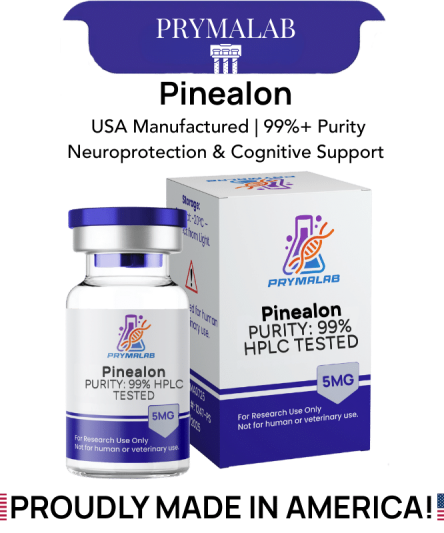
Pinealon peptide 5mg is a lyophilized vial of the tripeptide Glu-Asp-Arg, written EDR, assigned to pineal and central nervous system tissue in the Khavinson bioregulator range. Its sequence is Cardiogen with the first residue removed, which has an analytical consequence worth knowing.
Specification Table
Pinealon chemical and handling data
| Property |
Value |
| Compound |
Pinealon |
| Sequence designation |
EDR |
| Amino acid sequence |
Glutamate-Aspartate-Arginine |
| Sequence provenance |
Secondary sources, converging. Not traced to a single primary citation. Confirm against the lot certificate before relying on it for calculation |
| Residue count |
3 |
| Molecular weight, calculated |
418.4 g/mol, computed from standard residue masses plus water rather than quoted from a paper |
| Truncation relationship |
Identical to Cardiogen (Ala-Glu-Asp-Arg) with the amino-terminal alanine removed |
| Net charge at neutral pH |
Net positive, one strongly basic residue against two acidic |
| Oxidation-prone residues |
None |
| Chromophore |
None. Concentration cannot be determined by 280 nm absorbance |
| Compound class |
Short peptide bioregulator, cytogen subclass |
| Source tissue of the parent fraction |
Pineal gland and central nervous tissue |
| Originating programme |
St Petersburg Institute of Bioregulation and Gerontology |
| Proposed mechanism in the literature |
Sequence-specific interaction with DNA, modulating tissue-associated gene expression |
| Mechanism status |
Hypothesis. Not independently established outside the originating programme |
| Receptor |
None identified |
| Appearance |
White lyophilized powder |
| Purity |
Per lot-specific certificate of analysis |
| Solubility |
Water soluble |
| Storage, lyophilized |
2-8°C or -20°C, protected from light and moisture |
| Regulatory status |
No approved human or veterinary formulation in any jurisdiction |
Why Is Pinealon Peptide Cardiogen Minus One Residue?
Lining the family sequences up surfaces a relationship that changes how both compounds should be verified, and nobody selling either appears to mention it.
Cardiogen is Ala-Glu-Asp-Arg. Pinealon peptide is Glu-Asp-Arg. Remove the amino-terminal alanine from the first and you have the second exactly.
Solid-phase synthesis builds a peptide from the carboxy terminus backwards, so the alanine is the last residue added when making Cardiogen. A coupling that fails at that final step yields Pinealon.
That makes Pinealon a plausible impurity in any Cardiogen preparation, and it is not an exotic one. Incomplete final couplings are among the commonest synthesis defects there are.
The reverse also holds in a different way. A Pinealon preparation contaminated with Cardiogen would carry an extra 71 daltons on the contaminating species, which is resolvable but only if someone looks for it.
Chonluten and Epitalon stand in exactly the same relationship, with Chonluten being Epitalon minus its terminal alanine. Two des-alanine pairs in one compound family is a pattern rather than a coincidence.
What Does That Mean for Verifying Pinealon Peptide?
The truncation relationship converts a general quality question into a specific and answerable one.
Ask whether the chromatogram shows a peak at the Cardiogen retention time. Cardiogen is more hydrophobic than Pinealon by one alanine, so it elutes later on reversed-phase and separates cleanly given a competent gradient.
Ask whether the mass spectrum shows a species at roughly 489.5 alongside the expected 418.4. That 71 dalton gap is the alanine, and it is large enough for any instrument to resolve.
Those two questions are more useful than a purity percentage, because they name the specific impurity most likely to be present rather than asking about impurities in general.
The same logic runs the other way for anyone buying Cardiogen, where Pinealon at 418.4 is the species to look for.
A supplier who synthesises both compounds in the same facility has a cross-contamination route as well as a truncation route, which makes the question more pointed rather than less.
What Does the Arginine Contribute?
Pinealon peptide shares its terminal arginine with Cardiogen, and that residue drives most of the handling difference from the rest of the family.
Arginine carries a guanidinium group with a pKa near 12.5, so it stays protonated and positively charged across every pH a laboratory works at. Two acidic residues sit against it, but the net charge remains positive.
Basic peptides adsorb to the negatively charged surfaces of ordinary glass and plastic, and the proportional loss rises as working concentration falls. Low-binding consumables matter here in a way they do not for the neutral members of the family.
Counterion load rises alongside it, since trifluoroacetate prefers basic residues and a guanidinium group makes a strong binding site, leaving this peptide carrying more counterion per mole than its neutral relatives.
On reversed-phase silica the arginine can produce peak tailing through interaction with residual free silanols. That is a method artefact rather than an impurity, and mistaking one for the other is easy.
At 418.4 daltons a single trifluoroacetate at 114 is over 21 percent of the associated mass, which makes net peptide content a substantial correction rather than an administrative field.
What Pinealon Peptide Benefits Have Been Measured?
The published endpoints are narrower than the search phrasing, and separating them is more useful than blurring them.
Work from the originating programme reports central nervous system observations in aged rodent models, including behavioural measures and markers of tissue-associated gene expression in brain tissue.
Cell-culture work across the family reports chromatin decondensation, which is advanced in support of the DNA-binding hypothesis rather than of any tissue-specific claim.
Pinealon is among the more studied members of the family within that programme, alongside Epitalon and Vilon, so the primary record here is thicker than for compounds such as Vesilute.
What is absent is a well-powered independent Western clinical trial, which is the defining feature of the whole bioregulator literature rather than of this compound.
Settled chemistry, a documented research record and an unresolved mechanism are three separate things, and merging them is what produces overclaiming across this area.
What Pinealon Peptide Dosage Figures Are Published?
Each figure below comes out of a published study, using whichever species that particular study worked in.
Rodent work sits in the microgram per kilogram band by parenteral routes, in line with the rest of the Khavinson range.
The Russian clinical record describes ten to twenty day courses at tens to low hundreds of micrograms, structured as discrete blocks rather than continuous exposure.
Pinealon also appears in oral and sublingual preparations within the family literature, and figures drawn from those routes are not comparable with parenteral ones without accounting for absorption.
With no receptor affinity on record, no single concentration can be defended from first principles, which makes wide ranging a requirement here.
Converting between species calls for allometric scaling by body surface area, not simple body-weight arithmetic.
How Does Pinealon Peptide Compare Across the Three Fill Sizes?
Three Pinealon formats sit in this catalogue and the choice between them is about programme shape rather than chemistry.
Pinealon peptide at 5mg supplies roughly 12 micromoles, which for a compound studied at microgram per kilogram amounts covers a great deal of work. Material is rarely the limiting factor in this family.
The 10mg format suits a defined study long enough that lot continuity matters, holding synthesis variation constant across a whole series rather than across one experiment.
The 20mg format is a bulk purchase and it makes sense mainly where animal work is planned, since that consumes at rates a small vial cannot sustain.
Against the larger fills, this compound is stable enough dry that the usual argument for buying small does not apply. There is no aggregation clock running the way there is on a lipidated peptide.
The practical determinant is therefore whether a single lot should underwrite the whole programme, and for a family where synthesis truncation is a live concern the answer is usually yes.
How Should Pinealon 5mg Be Handled?
Five milligrams at roughly 418.4 daltons is approximately 12 micromoles, a generous molar quantity for a compound studied at microgram per kilogram amounts.
No cysteine, no methionine, no tryptophan and no asparagine-glycine motif, so the routes that degrade most peptides are unavailable.
Hold the dry powder sealed, dark and dry, at 2 to 8 degrees Celsius or colder.
Use low-binding consumables at working concentrations, because the net positive charge binds to ordinary surfaces and the loss is worst exactly where concentrations are lowest.
Water solubility is good, so let diluent run down the inside of the vial and swirl rather than shake.
Log the lot, the measured mass, whether a Cardiogen peak was looked for, counterion, net peptide content, diluent, volume, concentration and date.
A closing note on where Pinealon sits in the two family series. Its Glu-Asp opening places it with Chonluten and Vesugen among the compounds lacking a fourth-position lysine or alanine at the front.
Its arginine terminus places it with Cardiogen. That combination makes it the bridge between the truncated tripeptides and the charged tetrapeptides, and the only compound carrying both properties.
Anyone assembling a comparison panel across this family should include it for that reason rather than for its assigned tissue.
It is the compound most likely to behave unlike its neighbours for reasons that have nothing to do with the programme claim.
One further practical note for anyone stocking several of these compounds at once. The des-alanine pairs mean two of them can appear in each other vials through synthesis failure rather than through mislabelling.
That is a different failure mode from the near-isobaric pairs elsewhere in this family, where the risk is misidentification rather than contamination, and it calls for a different check.
For isobaric pairs you need better resolution. For truncation pairs you need someone to look at the right retention time.
Both checks are cheap. Neither is routine.
A closing point on the assigned tissue. Pinealon is filed against pineal gland and central nervous tissue, which is two assignments rather than one, and the family literature uses them somewhat interchangeably.
Those are not the same target. The pineal gland is a discrete organ and the central nervous system is not, so a compound claimed for both is carrying a broader assignment than most of its relatives.
Published Literature
References verified against the publisher record. This literature originates almost entirely from one research programme.
- Khavinson VK, Malinin VV. Gerontological Aspects of Genome Peptide Regulation. Karger, Basel; 2005.
- Khavinson VK. Neuroendocrinology Letters. 2002;23(Suppl 3):11-144.
- Anisimov VN, Khavinson VK. Critical Reviews in Oncology/Hematology. 2010;74(1):46-66.
- Fedoreyeva LI, Kireev II, Khavinson VK, Vanyushin BF. Biochemistry (Moscow). 2011;76(11):1210-1219.
- Khavinson VK, Solovyov AY, Zhilinsky DV, Shataeva LK, Bandaletova TY. Bulletin of Experimental Biology and Medicine. 2012;153(4):500-505.
Frequently Asked Questions
What is Pinealon peptide 5mg?
A lyophilized vial of the tripeptide Glu-Asp-Arg, written EDR, assigned to pineal and central nervous system tissue in the Khavinson bioregulator range. Laboratory research use only, approved nowhere.
How does it relate to Cardiogen?
It is Cardiogen with the amino-terminal alanine removed. Cardiogen is Ala-Glu-Asp-Arg and Pinealon is Glu-Asp-Arg, so the two differ by exactly one residue at the front.
Why does that matter for synthesis?
Because solid-phase synthesis builds from the carboxy terminus backwards, making alanine the last residue added when producing Cardiogen. A failed final coupling yields Pinealon, which makes it a plausible impurity.
Is that a common defect?
Incomplete final couplings are among the commonest synthesis defects there are. This is not an exotic failure mode, which is why naming the specific impurity is more useful than asking about purity generally.
How would contamination be detected?
A mass spectrum showing a species near 489.5 alongside the expected 418.4, since that 71 dalton gap is the alanine. Or a chromatogram peak at the Cardiogen retention time, which elutes later being more hydrophobic.
Is there a second pair like this?
Yes. Chonluten is Epitalon minus its terminal alanine, exactly as Pinealon is Cardiogen minus its terminal alanine. Two des-alanine pairs in one family is a pattern rather than a coincidence.
What does the arginine change?
It gives the peptide a net positive charge across every working pH, since the guanidinium group has a pKa near 12.5 and stays protonated. That drives adsorption, counterion load and chromatographic behaviour.
How large is the counterion correction?
At 418.4 daltons a single trifluoroacetate at 114 is over 21 percent of the associated mass, and arginine binds it preferentially. Net peptide content is a substantial correction here rather than an administrative field.
Why can peaks tail on reversed-phase?
Because arginine interacts with residual free silanols on the silica surface. That tailing is a method artefact rather than an impurity, and the two are easy to confuse when reading a chromatogram.
What has been measured?
Central nervous system observations in aged rodent models including behavioural measures and gene-expression markers in brain tissue, plus family-wide cell-culture work reporting chromatin decondensation.
Are oral figures comparable with injectable ones?
No. Pinealon appears in oral and sublingual preparations in the family literature, and figures from those routes cannot be compared with parenteral amounts without accounting for absorption differences.
Compliance Statement
Pinealon peptide is sold exclusively for laboratory research use. It is not a drug, food, or cosmetic product, and it is not a dietary product of any kind. It is not approved by the FDA or any comparable authority for human or veterinary use, its proposed mechanism has not been independently established, and amounts cited are figures from published studies in the species those studies used. This product is not intended to diagnose, treat, cure, or prevent any disease. It must not be given to humans or animals. Purchase is restricted to qualified researchers and institutions operating within applicable laws. All handling is the responsibility of the purchasing laboratory.









19 reviews for Pinealon 5mg